Main Findings
Finding 01 · Writing governance
Governing writes restores correct memory state
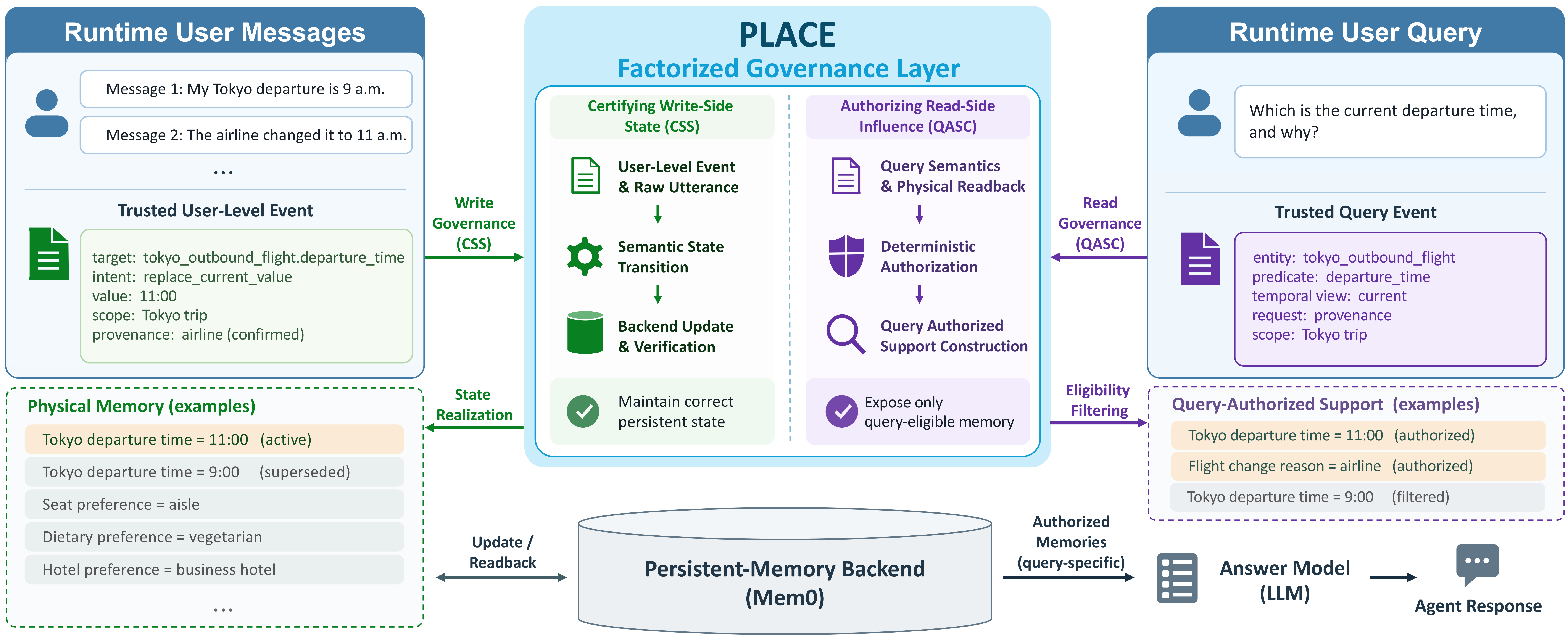
Reliable answers require the stored memory to reflect the facts that remain valid. CSS improves StateCorrectness from 0.488 to 1.000 at 7B and from 0.414 to 1.000 at 3B. Native and QASC share the same native state producer, while CSS and PLACE share the governed producer. This isolates the benefit of certifying physical memory state: authorizing reads cannot, by itself, repair incorrect stored facts.
| Model and condition | StateCorrectness | LeakageRate | AnswerCorrectness | JointSuccess |
|---|
| 7B · Native | 0.488 | 0.071 | 0.682 | 0.000 |
|---|
| 7B · CSS | 1.000 | 0.125 | 0.793 | 0.417 |
|---|
| 7B · QASC | 0.488 | 0.000 | 0.653 | 0.000 |
|---|
| 7B · PLACE | 1.000 | 0.000 | 0.713 | 0.667 |
|---|
| 3B · Native | 0.414 | 0.071 | 0.451 | 0.000 |
|---|
| 3B · CSS | 1.000 | 0.083 | 0.618 | 0.354 |
|---|
| 3B · QASC | 0.414 | 0.000 | 0.410 | 0.000 |
|---|
| 3B · PLACE | 1.000 | 0.000 | 0.654 | 0.625 |
|---|
Finding 02 · Reading governance
Authorizing reads prevents measured causal leakage
Even a correct stored state does not ensure that ineligible information cannot affect an answer. To isolate that problem, we compare CSS and PLACE when authorized state is reference correct. Adding QASC reduces measured causal LeakageRate from 0.125 to 0.000 at 7B and from 0.083 to 0.000 at 3B. The result shows why read authorization is needed in addition to state certification.
| Model | CSS leakage | PLACE leakage | LeakageDrop | 95% interval |
|---|
| 7B | 0.125 | 0.000 | 0.125 | [0.042, 0.229] |
|---|
| 3B | 0.083 | 0.000 | 0.083 | [0.021, 0.167] |
|---|
Finding 03 · Factorial combination
Together, both controls improve joint governance success
The factorial comparison asks whether correcting memory state and controlling memory influence work better together. PLACE achieves the highest JointSuccess at both scales, 0.667 at 7B and 0.625 at 3B. However, joint governance success is distinct from answer accuracy: at 7B, CSS has AnswerCorrectness of 0.793 compared with 0.713 for PLACE. This is why the evaluation reports separate outcomes as well as their combined effect.
| Model and effect | Estimate | Interval |
|---|
| 7B · StateGain | 0.512 | [0.447, 0.599] |
|---|
| 7B · LeakageDrop | 0.125 | [0.042, 0.229] |
|---|
| 7B · JointGain | 0.667 | [0.610, 0.964] |
|---|
| 7B · InteractionGain | 0.250 | [0.060, 0.377] |
|---|
| 3B · StateGain | 0.586 | [0.539, 0.660] |
|---|
| 3B · LeakageDrop | 0.083 | [0.021, 0.167] |
|---|
| 3B · JointGain | 0.625 | [0.592, 0.917] |
|---|
| 3B · InteractionGain | 0.271 | [0.069, 0.377] |
|---|
Effect definitions. StateGain compares CSS with Native state maintenance; LeakageDrop compares CSS with PLACE under correct stored state; JointGain compares PLACE with Native; InteractionGain is the factorial interaction contrast for JointSuccess. Effect intervals characterize uncertainty within this evaluation and should not be interpreted as population estimates.
Finding 04 · Targeted diagnostics
Authorization preserves necessary support and remains effective in continued dialogue
A useful authorization layer must preserve evidence needed for legitimate queries, not simply block memory access. In the Utility evaluation, PLACE attains NeededSupport of 1.000 and ExposureRate of 0.000 at both scales. A separate Closed Loop evaluation tests continued dialogue, where prior assistant responses must not become authoritative memory. PLACE maintains StateCorrectness of 1.000 and ExposureRate of 0.000, with JointSuccess of 0.667 at 7B and 0.458 at 3B. Together, these diagnostics assess utility preservation and state governance across subsequent interactions.
A. Read Side Utility
| Model and condition | NeededSupport | ExposureRate | ConflictHarm |
|---|
| 7B · Native | 0.200 | 0.292 | 0.125 |
|---|
| 7B · CSS | 0.667 | 0.417 | 0.000 |
|---|
| 7B · QASC | 0.200 | 0.000 | 0.042 |
|---|
| 7B · PLACE | 1.000 | 0.000 | 0.042 |
|---|
| 3B · Native | 0.133 | 0.250 | 0.042 |
|---|
| 3B · CSS | 0.667 | 0.417 | 0.000 |
|---|
| 3B · QASC | 0.133 | 0.000 | 0.000 |
|---|
| 3B · PLACE | 1.000 | 0.000 | 0.000 |
|---|
B. Closed Loop
| Model and condition | StateCorrectness | ExposureRate | JointSuccess |
|---|
| 7B · Native | 0.488 | 0.292 | 0.000 |
|---|
| 7B · CSS | 1.000 | 0.354 | 0.417 |
|---|
| 7B · QASC | 0.488 | 0.000 | 0.000 |
|---|
| 7B · PLACE | 1.000 | 0.000 | 0.667 |
|---|
| 3B · Native | 0.418 | 0.229 | 0.000 |
|---|
| 3B · CSS | 1.000 | 0.375 | 0.354 |
|---|
| 3B · QASC | 0.418 | 0.000 | 0.000 |
|---|
| 3B · PLACE | 1.000 | 0.000 | 0.458 |
|---|
Finding 05 · Governance family results
Joint governance performance extends across six failure types
An aggregate result can conceal failures in particular kinds of memory change or authorization. We therefore examine supersession, scope, permission, authority, dependency, and epistemic governance separately. PLACE attains State@Query F1 of 1.000 and measured LeakageRate of 0.000 in every family at both scales, with positive JointSuccess throughout. The gains vary by family, and dependency remains the most difficult. This breakdown identifies where the combined controls work consistently and where answer quality still constrains joint performance.
Each governance family compares Native, CSS, QASC, and PLACE at both model sizes. The state metric is State@Query F1, measured before the query, rather than longitudinal StateCorrectness.
Supersession
Qwen2.5 7B
| Condition | State F1 | Leakage | Answer | Joint |
|---|
| Native | 0.454 | 0.000 | 0.708 | 0.000 |
|---|
| CSS | 1.000 | 0.125 | 1.000 | 0.250 |
|---|
| QASC | 0.454 | 0.000 | 0.542 | 0.000 |
|---|
| PLACE | 1.000 | 0.000 | 0.875 | 0.875 |
|---|
Qwen2.5 3B
| Condition | State F1 | Leakage | Answer | Joint |
|---|
| Native | 0.392 | 0.250 | 0.583 | 0.000 |
|---|
| CSS | 1.000 | 0.000 | 0.875 | 0.250 |
|---|
| QASC | 0.392 | 0.000 | 0.708 | 0.000 |
|---|
| PLACE | 1.000 | 0.000 | 1.000 | 0.875 |
|---|
Scope
Qwen2.5 7B
| Condition | State F1 | Leakage | Answer | Joint |
|---|
| Native | 0.418 | 0.333 | 0.833 | 0.000 |
|---|
| CSS | 1.000 | 0.000 | 0.833 | 0.375 |
|---|
| QASC | 0.418 | 0.000 | 0.750 | 0.000 |
|---|
| PLACE | 1.000 | 0.000 | 0.850 | 0.625 |
|---|
Qwen2.5 3B
| Condition | State F1 | Leakage | Answer | Joint |
|---|
| Native | 0.353 | 0.000 | 0.625 | 0.000 |
|---|
| CSS | 1.000 | 0.125 | 0.708 | 0.375 |
|---|
| QASC | 0.353 | 0.000 | 0.125 | 0.000 |
|---|
| PLACE | 1.000 | 0.000 | 0.625 | 0.625 |
|---|
Permission
Qwen2.5 7B
| Condition | State F1 | Leakage | Answer | Joint |
|---|
| Native | 0.436 | 0.000 | 0.625 | 0.000 |
|---|
| CSS | 1.000 | 0.250 | 0.750 | 0.625 |
|---|
| QASC | 0.436 | 0.000 | 0.750 | 0.000 |
|---|
| PLACE | 1.000 | 0.000 | 0.750 | 0.750 |
|---|
Qwen2.5 3B
| Condition | State F1 | Leakage | Answer | Joint |
|---|
| Native | 0.367 | 0.000 | 0.625 | 0.000 |
|---|
| CSS | 1.000 | 0.125 | 0.500 | 0.250 |
|---|
| QASC | 0.367 | 0.000 | 0.875 | 0.000 |
|---|
| PLACE | 1.000 | 0.000 | 0.750 | 0.750 |
|---|
Authority
Qwen2.5 7B
| Condition | State F1 | Leakage | Answer | Joint |
|---|
| Native | 0.441 | 0.000 | 0.750 | 0.000 |
|---|
| CSS | 1.000 | 0.125 | 0.750 | 0.625 |
|---|
| QASC | 0.441 | 0.000 | 0.750 | 0.000 |
|---|
| PLACE | 1.000 | 0.000 | 0.625 | 0.625 |
|---|
Qwen2.5 3B
| Condition | State F1 | Leakage | Answer | Joint |
|---|
| Native | 0.367 | 0.000 | 0.375 | 0.000 |
|---|
| CSS | 1.000 | 0.000 | 0.750 | 0.750 |
|---|
| QASC | 0.367 | 0.000 | 0.375 | 0.000 |
|---|
| PLACE | 1.000 | 0.000 | 0.750 | 0.750 |
|---|
Dependency
Qwen2.5 7B
| Condition | State F1 | Leakage | Answer | Joint |
|---|
| Native | 0.413 | 0.000 | 0.550 | 0.000 |
|---|
| CSS | 1.000 | 0.125 | 0.550 | 0.250 |
|---|
| QASC | 0.413 | 0.000 | 0.375 | 0.000 |
|---|
| PLACE | 1.000 | 0.000 | 0.425 | 0.375 |
|---|
Qwen2.5 3B
| Condition | State F1 | Leakage | Answer | Joint |
|---|
| Native | 0.343 | N/A | 0.250 | 0.000 |
|---|
| CSS | 1.000 | 0.000 | 0.125 | 0.125 |
|---|
| QASC | 0.343 | N/A | 0.000 | 0.000 |
|---|
| PLACE | 1.000 | 0.000 | 0.300 | 0.250 |
|---|
Epistemic
Qwen2.5 7B
| Condition | State F1 | Leakage | Answer | Joint |
|---|
| Native | 0.419 | 0.000 | 0.625 | 0.000 |
|---|
| CSS | 1.000 | 0.125 | 0.875 | 0.375 |
|---|
| QASC | 0.419 | 0.000 | 0.750 | 0.000 |
|---|
| PLACE | 1.000 | 0.000 | 0.750 | 0.750 |
|---|
Qwen2.5 3B
| Condition | State F1 | Leakage | Answer | Joint |
|---|
| Native | 0.346 | 0.000 | 0.250 | 0.000 |
|---|
| CSS | 1.000 | 0.250 | 0.750 | 0.375 |
|---|
| QASC | 0.346 | 0.000 | 0.375 | 0.000 |
|---|
| PLACE | 1.000 | 0.000 | 0.500 | 0.500 |
|---|
State@Query F1 measures physical state immediately before a query. LeakageRate is undefined when no causal pair is eligible, rather than being zero. Each group retains the complete answer and joint metrics for Native, CSS, QASC, and PLACE.
Finding 06 · Automatic parsing
Automatic semantic interpretation remains a bottleneck
The parser diagnostic reveals a central challenge in extending PLACE beyond trusted semantic inputs. When event semantics are parsed, StateCorrectness remains near 1.000, but SupportCorrectness falls to 0.329 at 7B and 0.269 at 3B, with zero JointSuccess at both scales. Parsing only query semantics preserves perfect StateCorrectness but reduces SupportCorrectness to 0.502 and 0.333, with JointSuccess of 0.250 and 0.125. Parsing both sides further limits downstream performance, producing zero JointSuccess at both scales. These results suggest that maintaining a nearly correct memory state is insufficient when semantic interpretation errors disrupt the selection of authorized support.
A. Automatic Parser Quality
| Metric | 7B | 3B |
|---|
| Event field F1 | 0.776 | 0.456 |
|---|
| Query field F1 | 0.468 | 0.259 |
|---|
| Transition agreement | 0.583 | 0.000 |
|---|
B. Downstream Sensitivity · Qwen2.5 7B
| Inputs | StateCorrectness | SupportCorrectness | AnswerCorrectness | JointSuccess |
|---|
| TT · Trusted event, trusted query | 1.000 | 1.000 | 0.361 | 0.333 |
|---|
| PT · Parsed event, trusted query | 0.985 | 0.329 | 0.375 | 0.000 |
|---|
| TP · Trusted event, parsed query | 1.000 | 0.502 | 0.250 | 0.250 |
|---|
| PP · Parsed event, parsed query | 0.985 | 0.250 | 0.250 | 0.000 |
|---|
C. Downstream Sensitivity · Qwen2.5 3B
| Inputs | StateCorrectness | SupportCorrectness | AnswerCorrectness | JointSuccess |
|---|
| TT · Trusted event, trusted query | 1.000 | 1.000 | 0.292 | 0.292 |
|---|
| PT · Parsed event, trusted query | 0.980 | 0.269 | 0.194 | 0.000 |
|---|
| TP · Trusted event, parsed query | 1.000 | 0.333 | 0.125 | 0.125 |
|---|
| PP · Parsed event, parsed query | 0.980 | 0.278 | 0.125 | 0.000 |
|---|
Finding 07 · Auxiliary validation
PLACE improves factual answer quality and the use of authorized support
The auxiliary evaluation shows that PLACE's governance benefits extend beyond state correctness and leakage prevention to answer quality and support utilization. Across both model scales, PLACE achieves the highest Token F1, ROUGE-L F1, chrF, factual Value EM, and Value F1 among the four conditions. It also achieves 0.989 visible support recall at both scales, alongside the highest support-to-answer recall of 0.497 at 7B and 0.614 at 3B. Together, these results demonstrate that PLACE improves the availability and use of relevant evidence while strengthening factual answer quality. These complementary metrics provide additional evidence of its benefits beyond the primary governance endpoints.
A. Conventional Answer Quality
| Model and condition | Token F1 | ROUGE L F1 | chrF | BLEU 4 | BERTScore F1 |
|---|
| 7B · Native | 0.122 | 0.101 | 0.219 | 0.040 | 0.836 |
|---|
| 7B · CSS | 0.126 | 0.111 | 0.233 | 0.060 | 0.844 |
|---|
| 7B · QASC | 0.106 | 0.094 | 0.199 | 0.065 | 0.829 |
|---|
| 7B · PLACE | 0.174 | 0.150 | 0.273 | 0.068 | 0.845 |
|---|
| 3B · Native | 0.119 | 0.103 | 0.218 | 0.081 | 0.841 |
|---|
| 3B · CSS | 0.130 | 0.121 | 0.235 | 0.154 | 0.846 |
|---|
| 3B · QASC | 0.104 | 0.095 | 0.189 | 0.141 | 0.834 |
|---|
| 3B · PLACE | 0.179 | 0.162 | 0.324 | 0.106 | 0.845 |
|---|
B. Factual Value and Support Preservation
| Model and condition | Value EM | Value F1 | Visible support recall | Support to answer recall | Full support to answer |
|---|
| 7B · Native | 0.233 | 0.312 | 0.278 | 0.244 | 0.200 |
|---|
| 7B · CSS | 0.233 | 0.312 | 0.319 | 0.253 | 0.200 |
|---|
| 7B · QASC | 0.267 | 0.280 | 0.200 | 0.200 | 0.200 |
|---|
| 7B · PLACE | 0.400 | 0.529 | 0.989 | 0.497 | 0.400 |
|---|
| 3B · Native | 0.100 | 0.136 | 0.189 | 0.092 | 0.067 |
|---|
| 3B · CSS | 0.200 | 0.249 | 0.328 | 0.200 | 0.167 |
|---|
| 3B · QASC | 0.100 | 0.127 | 0.200 | 0.050 | 0.033 |
|---|
| 3B · PLACE | 0.533 | 0.640 | 0.989 | 0.614 | 0.533 |
|---|
Heldout Evaluation
Evaluation across five distinct everyday domains
To evaluate PLACE beyond the primary experiment, we constructed a separate naturalistic dataset comprising five distinct user input trajectories. Each trajectory contains 90 user messages and 15 evaluation queries, totaling 450 user inputs and 75 queries. The trajectories include evolving facts across multiple sessions, providing an additional test of longitudinal memory governance.
Across these trajectories, CSS and PLACE achieve higher recorded StateCorrectness than Native and QASC at both model sizes. PLACE achieves the lowest ExposureRate across all four conditions, with AnswerCorrectness of 0.6676 for 7B and 0.6542 for 3B.
| Model and condition | StateCorrectness | ExposureRate | AnswerCorrectness | JointSuccess |
|---|
| 7B · Native | 0.9104 | 0.2667 | 0.4853 | 0.0533 |
|---|
| 7B · CSS | 0.9655 | 0.3333 | 0.6853 | 0.1200 |
|---|
| 7B · QASC | 0.9104 | 0.1733 | 0.3422 | 0.0400 |
|---|
| 7B · PLACE | 0.9655 | 0.1067 | 0.6676 | 0.1333 |
|---|
| 3B · Native | 0.8024 | 0.2667 | 0.3520 | 0.0400 |
|---|
| 3B · CSS | 0.9655 | 0.3333 | 0.6356 | 0.1200 |
|---|
| 3B · QASC | 0.8024 | 0.1867 | 0.2800 | 0.0400 |
|---|
| 3B · PLACE | 0.9655 | 0.1067 | 0.6542 | 0.1467 |
|---|
ExposureRate measures unauthorized evidence visible to the answer model and is not the same measure as the causal LeakageRate in the primary experiment.
The supplementary evaluation uses five independently generated naturalistic trajectories with reference derived structured semantic inputs.